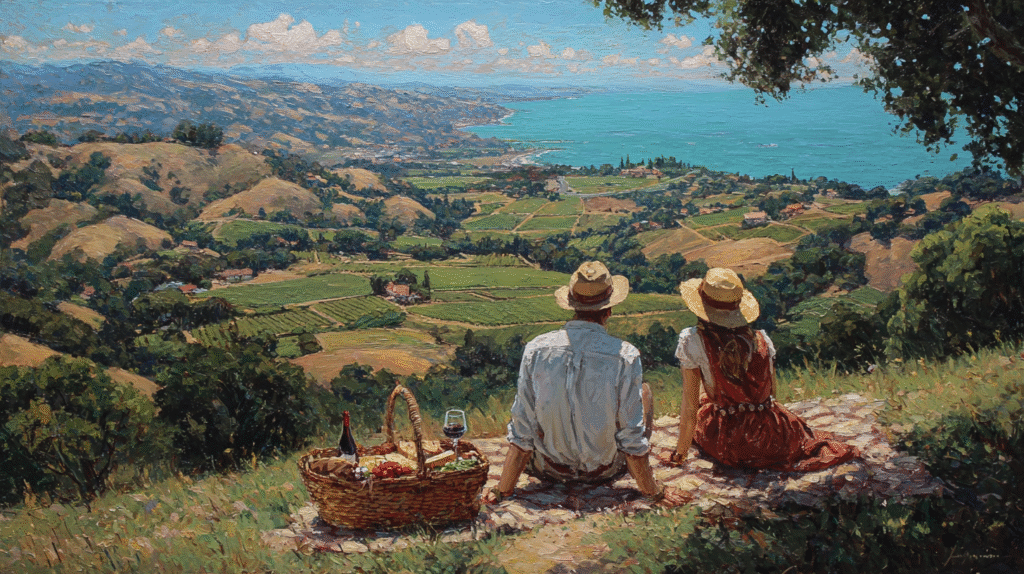
Pinot Noir is cultivated across a remarkable range of regions, each shaping the grape in distinctive ways. Burgundy in France remains its historic benchmark; Oregon and California have developed influential New World identities; New Zealand expresses it with clarity and lift; Germany’s Spätburgunder continues to gain global recognition; and in Champagne, the variety plays a central role in both still and sparkling wines. While its global footprint is extensive, this article concentrates on a more local comparison, focusing specifically on Oregon and California to explore how climate, geology, and regional philosophy shape two of the most compelling expressions of Pinot Noir in the United States.
Pinot Noir: Oregon vs. California
A comprehensive viticultural, sensory, and regional analysis
1. Historical Overview
Oregon
Serious development of Pinot Noir in Oregon began in the mid-1960s when winemakers such as David Lett (The Eyrie Vineyards) established vines in the Willamette Valley, attracted by its Burgundian climate and soils. Oregon quickly developed a reputation for transparent, elegant expressions. Global recognition accelerated after The Eyrie Vineyards’ 1975 South Block Reserve placed highly against Burgundy in a 1979 tasting, which drew international attention and investment.
California
California planted Pinot Noir on a wider scale earlier than Oregon, with roots in the late 19th and early 20th centuries. Post-Prohibition growth accelerated in the 1950s and 1960s, supported by UC Davis research and pioneering estates such as Hanzell and Mount Eden, followed by a wave of Sonoma producers. California’s warmer climate encouraged a riper, darker-fruited profile, and today the state offers the broadest stylistic range of Pinot Noir in the United States.
2. Viticultural Notes
Grape Characteristics
Pinot Noir is thin-skinned, early-ripening, and highly sensitive to climate, clonal selection, canopy management, and soil vigor. Both Oregon and California commonly use Dijon clones (113, 114, 115, 667, 777), heritage clones (Pommard, Wädenswil), and in California, heritage selections such as Swan and Calera.
Oregon Practices
- Emphasis on lower yields to maintain concentration in cooler climates
- Slow, gradual ripening that preserves high natural acidity
- Frequent use of whole cluster fermentation at quality-focused estates
- Gentle extraction to protect aromatic detail and fine tannins
- Moderate new oak usage (roughly 20 to 40 percent), predominantly French cooperage
California Practices
- In warmer zones, canopy shading to prevent sunburn and manage sugar levels
- Coastal AVAs (Sonoma Coast, Santa Cruz Mountains, Sta. Rita Hills) rely on Pacific winds for long, balanced hang time
- Wider range of oak usage (approximately 25 to 60 percent new), depending on stylistic intent
- Partial whole cluster fermentation often used in cooler AVAs to add aromatic lift and spice
3. Regional & Terroir Profile
Oregon (primarily Willamette Valley AVA)
Climate: Cool, maritime influenced, with a long, mild growing season.
Soils: Diverse mix including volcanic Jory, marine sedimentary Willakenzie, and loess.
Impact on the Wine:
- Red fruit profile with bright cherry, cranberry, and pomegranate
- High natural acidity and a more linear structure
- Pronounced savory character and earthy, forest floor undertones
Key Sub-AVAs: Dundee Hills, Eola–Amity Hills, Yamhill-Carlton, Ribbon Ridge, Chehalem Mountains.
California
Climate: Ranges from cool-coastal (Sonoma Coast, Sta. Rita Hills) to moderately warm regions (Russian River Valley, Carneros).
Soils: Varied mix including Goldridge sandy loam, diatomaceous earth, shale, sandstone, and decomposed granite.
Impact on the Wine:
- Broader spectrum of fruit ripeness from red to dark fruit
- Richer mid-palate with softer tannins
- Capacity to produce both elegant coastal styles and fuller-bodied inland styles
Key AVAs: Sonoma Coast, Russian River Valley, Santa Lucia Highlands, Anderson Valley, Sta. Rita Hills, Santa Cruz Mountains.
4. Top Producers
Oregon
- The Eyrie Vineyards
- Domaine Serene
- Domaine Drouhin Oregon
- Cristom
- Beaux Frères
- Bergström
- Adelsheim
- Penner-Ash
- Archery Summit
- Evening Land
California
- Kosta Browne
- Williams Selyem
- Littorai
- Hirsch Vineyards
- Calera
- Paul Hobbs
- Sea Smoke
- Rhys Vineyards
- Flowers
- Rochioli
5. Flavor Profile Analysis
Oregon Pinot Noir
- ABV: Typically 12.5 to 13.8 percent
- Acidity: High
- Residual Sugar: Dry
- Tannins: Fine-grained, light to moderate
- Nose: Red cherry, cranberry, pomegranate, rose petal, dried herbs, forest floor, subtle spice
- Palate: Bright red fruits, mineral tension, savory earthiness, lively acidity, focused structure
- Finish: Long, linear, often herbal or mineral-driven
California Pinot Noir
- ABV: Approximately 13.5 to 15 percent, depending on AVA and style
- Acidity: Medium to medium-high
- Residual Sugar: Dry
- Tannins: Soft to moderate, with a silkier texture in warmer zones
- Nose: Ripe cherry, black raspberry, plum, cola, baking spice, vanilla, and occasional cocoa notes
- Palate: Fuller-bodied, richer fruit, rounder texture, often more pronounced oak influence
- Finish: Plush, fruit-driven, sometimes spice-accented and slightly warming
6. Food Pairing Recommendations
Charcuterie
Oregon Pinot Noir
- Cheeses: Morbier, Comté, aged goat cheese, mild blue cheeses
- Nuts: Hazelnuts, lightly roasted almonds
- Cured Meats: Speck, finocchiona, country pâté
- Accents: Tart cherry preserves, herbal mustards, cornichons
California Pinot Noir
- Cheeses: Brie, Camembert, triple-cream cow’s milk cheeses
- Nuts: Marcona almonds, toasted pecans
- Cured Meats: Prosciutto, salami with sweet spice, coppa
- Accents: Plum chutney, fig spread, caramelized onion jam
Appetizers
Oregon Pinot Noir
- Mushroom tartlets with thyme
- Beet salad with chèvre and toasted walnuts
- Smoked trout with crème fraîche and chives
- Roasted root vegetable skewers with herb oil
California Pinot Noir
- Pork rillettes with fruit compote
- Grilled figs stuffed with chèvre and herbs
- Ahi tuna on crispy wontons with light soy-ginger glaze
- Flatbread with caramelized onions and Gruyère
Entrées
Oregon Pinot Noir
- Herb-roasted chicken with pan jus
- Cedar-planked salmon with lemon and dill
- Duck breast with cherry or berry reduction
- Lentil stew with mushrooms and root vegetables (vegetarian)
- Beet and walnut risotto with herbs (vegan)
California Pinot Noir
- Grilled pork tenderloin with spice rub
- Blackened salmon or seared tuna with mild spice
- Short ribs with a lighter, Pinot-friendly glaze
- Mushroom and ricotta ravioli with sage butter (vegetarian)
- Roasted vegetable cassoulet with tomatoes and herbs (vegan)
Side Dishes
Oregon Pinot Noir
- Sautéed or roasted wild mushrooms
- Roasted carrots with honey and thyme
- Herbed polenta
- Farro with sage, shallots, and seasonal vegetables
California Pinot Noir
- Sweet corn with butter and herbs
- Roasted sweet potatoes with light spice
- Creamy Parmesan risotto
- Charred broccolini with garlic and lemon
7. Contextual Comparison
Oregon leans toward a cool-climate, Burgundy-inspired expression whose identity is built on restraint, purity, and earth-driven nuance. California offers a wider spectrum, ranging from coastal precision to boldly ripe styles. In broad terms, Oregon excels in subtlety and structure, while California delivers versatility and more immediately accessible fruit richness.
8. Serving & Storage Recommendations
Temperatures
- Oregon Pinot Noir: 55 to 58°F (13 to 14°C)
- California Pinot Noir: 58 to 60°F (14 to 16°C)
Glassware
Use a large Burgundy bowl with a generous surface area to encourage aromatic development and soften tannins.
Decanting
- Oregon: 30 to 45 minutes for young, structured bottles.
- California: 15 to 30 minutes; richer styles benefit from more aeration, but delicate coastal wines should not be over-decanted.
Drinking Window
- Oregon: Approximately 5 to 12 years, depending on producer and vintage.
- California: Around 4 to 10 years for coastal AVAs; 3 to 7 years for fuller inland styles.
Cellaring
Store at about 55°F (13°C) with moderate humidity, minimal light, and little to no vibration. Keep bottles on their side to maintain cork integrity.
9. Label & Classification Interpretation
Oregon
- AVA labels identify specific regions and sub-regions such as Willamette Valley and its nested AVAs.
- “Reserve” often denotes top parcels, barrel selections, or a higher tier in the producer’s range.
- Many labels highlight single-vineyard bottlings, emphasizing site expression.
California
- AVA indication is crucial given the state’s vast climatic diversity.
- “Estate Bottled” indicates that the winery grew the grapes on its own land within the listed AVA and produced and bottled the wine at the estate.
- Single-vineyard and “Reserve” terms are commonly used to signal higher quality tiers and distinct terroir.
In both states, AVA regulations are geographic rather than quality-graded systems, unlike European AOC or DOCG.
10. Awards, Ratings & Recent Vintages
Recent high-quality vintages in both regions, including 2018 and 2021, have drawn strong praise from major critics for balance, purity, and aging potential. Top estates from Oregon and California regularly receive scores in the mid-90s and above from publications such as Wine Spectator, Wine Advocate, and Decanter.
11. Market Position & Pricing
Oregon
Oregon Pinot Noir tends to occupy a premium position, with strong value at the 30 to 50 dollar range and luxury bottlings that can reach well above 100 dollars, especially from benchmark producers and limited single-vineyard sites.
California
California offers the broadest price spectrum, from approachable entry-level wines around 15 to 25 dollars to highly allocated cult bottlings at 150 dollars or more. Many coastal AVAs offer strong value in the 30 to 60 dollar range, especially from producers focusing on site-driven, low-yield vineyards.
12. Winemaker Philosophy & House Styles
In Oregon, producers often favor low-intervention methods, including native yeast fermentation, careful extraction, and restrained new oak, aiming to preserve delicacy and a clear sense of place. In California, approaches are more varied. Some estates mirror this restrained, site-first style, while others embrace a richer, more polished profile with riper fruit and more pronounced oak. The result is a wide spectrum, from taut, mineral coastal bottlings to plush, fruit-forward wines with generous texture.
13. Sustainability & Ethical Practices
Both Oregon and California are leaders in sustainable viticulture. In Oregon, many vineyards are certified by organizations such as LIVE and Salmon-Safe, and a significant number practice organic or biodynamic farming. In California, widespread adoption of California Sustainable Winegrowing Alliance standards, water conservation strategies, and organic certifications is common, especially among top coastal estates. Environmental stewardship is increasingly central to the identity of premier Pinot Noir producers in both regions.